The purchasing question
The cheapest GPU-hour is not necessarily the cheapest completed workload. A headline rate excludes the amount of billable time a job consumes and may exclude persistent storage, data movement, support, minimum commitments and tax.
01 · Cost metricStart with the completed workload
Record three figures separately: the provider's native quoted rate, the billable consumption under its start-and-stop rules, and the successful output produced at the required quality and deadline.
From list rate to useful compute
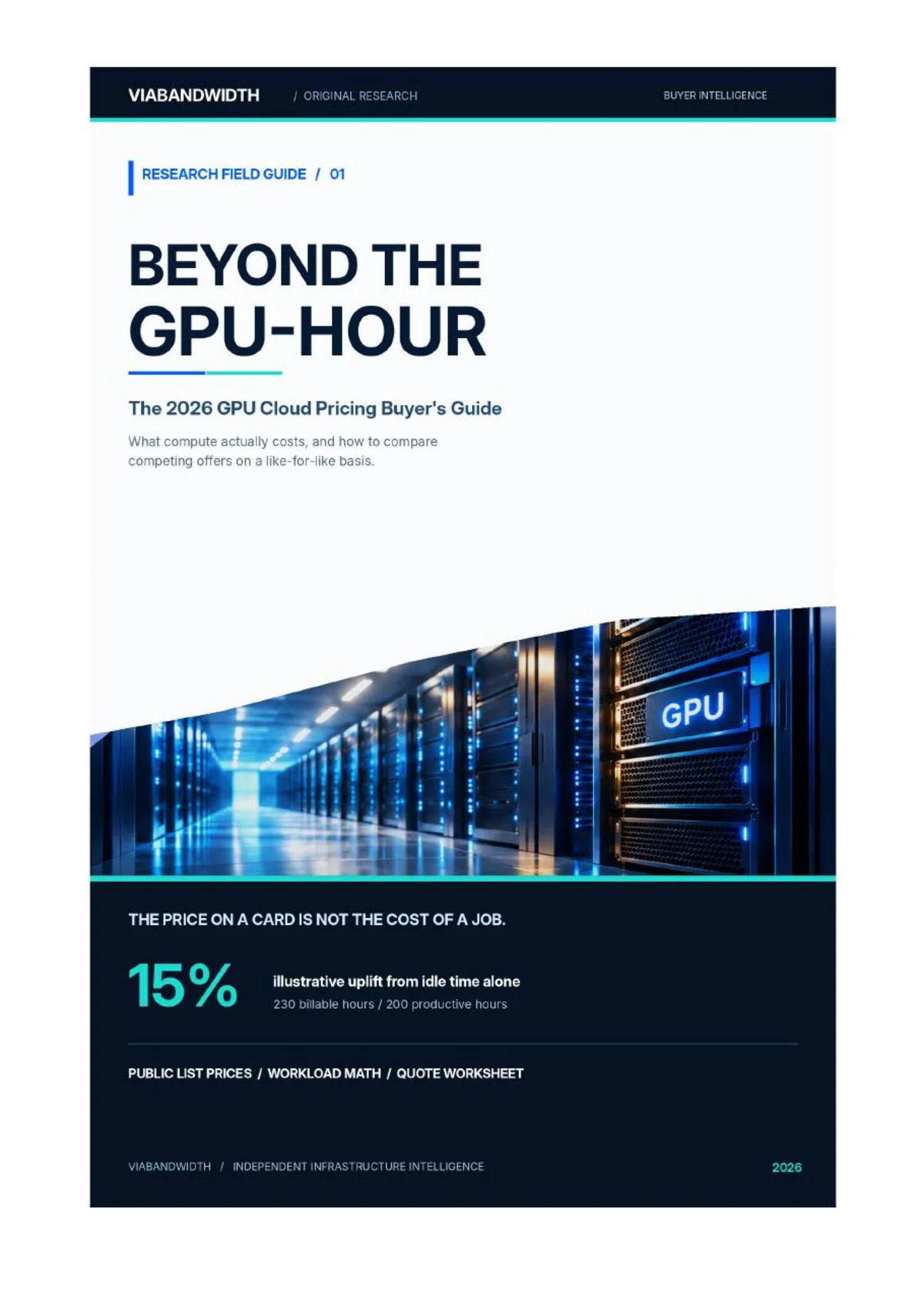
At Runpod's published $3.99 H100 SXM Pods rate, 230 billed hours for 200 productive hours produces a compute-only bill of $917.70, or $4.59 per productive GPU-hour. This is transparent arithmetic, not an observed Runpod workload or a claim about its idle behavior.
02 · Commercial structureWhat exactly are you buying?
The service boundary changes the meaning of every price.
A 1-GPU instance, an eight-GPU HGX node, a reserved cluster and a serverless model endpoint are different products. Dividing a node price by eight is useful only when all eight GPUs, the interconnect, CPU/RAM, storage and minimum purchase are recorded.
03 · Pricing evidencePublished rates: four GPU families
Official published price observations
| Provider and sold object | GPU | Native list rate |
|---|---|---|
| Runpod Pods | H100 SXM 80 GB | $3.99/GPU-hour |
| Lambda 1x instance | H100 SXM 80 GB | $4.29/GPU-hour |
| Runpod Pods | H200 141 GB | $5.29/GPU-hour |
| Crusoe GPU instance | H200 141 GB HGX | $4.29/GPU-hour |
| Lambda 1x instance | B200 SXM6 180 GB | $6.99/GPU-hour |
| Runpod Pods | B200 180 GB | $7.99/GPU-hour |
| Runpod Pods | A100 SXM 80 GB | $1.79/GPU-hour |
| Crusoe GPU instance | A100 SXM 80 GB | $2.30/GPU-hour |
Rates rechecked on 2 November 2026. Provider selectors, region, availability, attached resources and tax can change the transactable configuration. Only the two 1-GPU H100 SXM examples form the worked comparison below; the remaining rows are deliberately directional.
04 · Total billWhat the actual invoice includes
Unknown must remain unknown. It must not silently become zero.
The quote has five cost boundaries
- 01Compute: when does the meter begin, pause and stop?
- 02Storage: what persists after the instance terminates, and at what rate?
- 03Movement: which ingress, egress, cross-zone and interconnect rules apply?
- 04Service: which platform, scheduler and support charges are bundled?
- 05Contract: what remains payable if utilization is zero?
Lambda's billing documentation says running on-demand instances are billed even when unused and that filesystems continue billing while they exist. It also states that filesystem ingress and egress are not charged.
05 · Worked buyWhen the cheaper GPU-hour loses
If both H100 offers require 200 billable hours, Runpod's listed rate produces $798 in compute charges and Lambda's produces $858. But at Lambda's $4.29 rate, the break-even runtime is just under 186.01 hours for the same accepted workload.
When a higher rate can win
| Test | Runpod example | Lambda example |
|---|---|---|
| Same billed time | 200 h × $3.99 = $798 | 200 h × $4.29 = $858 |
| Break-even runtime | 200 h at agreed quality | Less than 186.01 h at the same quality |
| Unpriced obligations | Storage, network and tax: unknown | Storage, network and tax: unknown |
No benchmark supports the 186-hour premise. It is a break-even illustration, not a provider performance claim. Buyers must measure or contract the completed result.
06 · Buyer worksheetMake two quotations comparable
The downloadable eight-page field guide includes a two-supplier worksheet covering GPU variant and count, sold object, topology, host resources, region, commitment, billing increments, storage, data movement, support, tax, measured billable hours and all-in completed-workload cost.
| Required field | Supplier A | Supplier B |
|---|---|---|
| Seller / actual infrastructure operator | ____________ | ____________ |
| Official quote ID / issue & expiry dates | ____________ | ____________ |
| GPU model, variant, VRAM, count / MIG | ____________ | ____________ |
| Sold object: GPU / VM / node / endpoint | ____________ | ____________ |
| Topology, network fabric, CPU/RAM | ____________ | ____________ |
| Included / persistent storage | ____________ | ____________ |
| Region, residency, start date / SLA | ____________ | ____________ |
| Native price, currency, unit, tax status | ____________ | ____________ |
| On-demand / spot / reserved; duration | ____________ | ____________ |
| Billing increment, idle, pause, retry rules | ____________ | ____________ |
| Minimums, deposits, exit, renewal | ____________ | ____________ |
| Egress / cross-zone / data-movement fees | ____________ | ____________ |
| Support, platform and extra service charges | ____________ | ____________ |
| Proven billable hours / accepted output | ____________ | ____________ |
| All-in cost / completed workload | ____________ | ____________ |
07 · Findings and methodWhat the evidence can support
A large ledger is not a single price series
This is a buyer guide, not a market census or benchmark. It uses official public list rates and illustrative arithmetic. It does not claim tested throughput, current stock, identical bundles, negotiated pricing or supplier-specific idle behavior.
Historical context only: ViaBandwidth's private 60-offer Q2-to-October same-offer cohort included 41 unchanged prices, 15 increases and four decreases across 10 provider domains. That narrow cohort cannot establish market-wide price inflation.
Present this buyer guide
One sponsor can support this guide with a clearly labelled credit on the landing page, downloadable PDF and related GPU-pricing surfaces. Sponsorship never changes the evidence or supplier treatment.
- ▸Presented-by credit on the guide and downloadable PDF
- ▸A credit beside relevant GPU-pricing research
- ▸Exclusive to one sponsor for this guide
- ▸Labelled sponsorship with no influence over the analysis
Or write to [email protected].