ViaBandwidth buyer guide
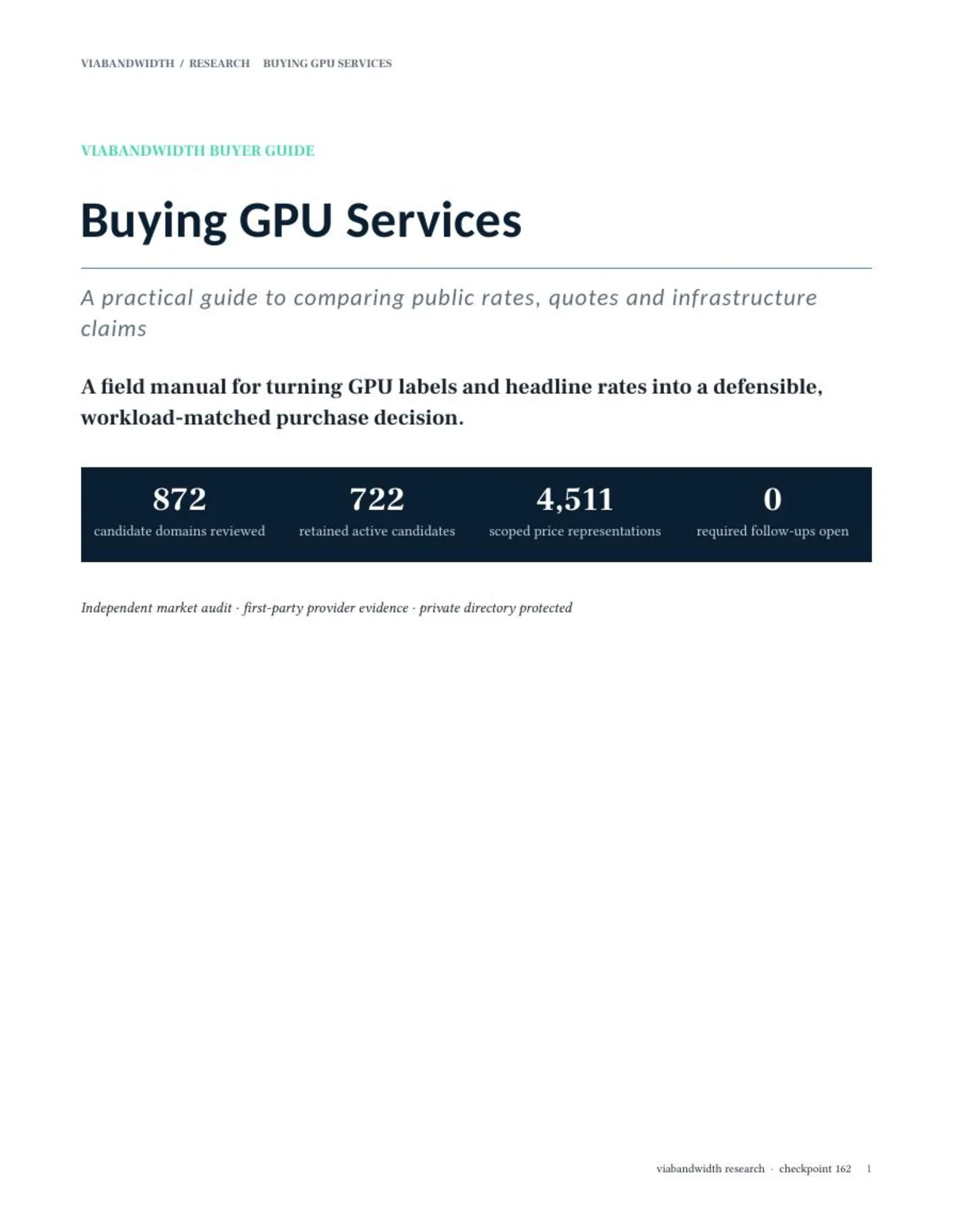
This field manual turns GPU labels, headline rates and infrastructure claims into a defensible, workload-matched purchase decision. The cheapest GPU is the wrong question until the workload, data path and service boundary are defined.
01 · WorkloadStart with the workload
Write the requirement before opening a provider comparison. Training, fine-tuning, inference, rendering, VDI and research create different requirements for memory, topology, persistence, scheduler and utilization.
| Workload question | Why it changes the buy |
|---|---|
| Training, fine-tuning, inference, rendering, VDI or research? | Changes model choice, interconnect, persistence, scheduler and utilization pattern. |
| Single GPU, multi-GPU or multi-node? | Determines whether node topology and east-west fabric dominate. |
| Burst, steady or deadline-driven? | Changes the value of on-demand, reservation, spot and dedicated capacity. |
| Data size and sensitivity? | Changes storage, egress, sovereignty, private connectivity and security requirements. |
| Framework and image constraints? | Changes driver/CUDA compatibility, managed-platform value and migration effort. |
| Human support tolerance? | Changes the balance between self-service price and managed delivery. |
02 · Supply modelChoose the right supply model
Direct cloud, marketplace capacity, dedicated servers, colocation and managed platforms solve different problems.
03 · ComparabilityMake prices comparable
Preserve the native offer first; normalize only inside a matched cohort.
| Field | Record exactly | Common failure |
|---|---|---|
| GPU | Model, variant, memory/profile, quantity | Treating variants or MIG slices as equivalent |
| Sold object | GPU, VM, server, node, pod, endpoint or output unit | Dividing a node into a synthetic GPU rate |
| Resources | CPU, RAM, storage, network, software/platform | Comparing component-only with all-in |
| Money | Native amount, currency and tax status | Assuming every “$” is USD or tax-inclusive |
| Time | Billing unit and minimum duration | Using 730 hours without matching commitment |
| Commitment | On-demand, spot, prepaid, reservation, term | Comparing three-year pricing with on-demand |
| Place | Region/facility and residency boundary | Ignoring regional price and availability |
| Evidence | URL, date, excerpt and card/table boundary | Joining unrelated fields from separate rows |
04 · QuoteInterrogate the quote
| Ask | A good answer contains |
|---|---|
| What exactly is allocated? | GPU count/variant, tenancy, topology, CPU/RAM/storage/network and software layer. |
| Is capacity available now? | Quantity, region, start date, lead time and reservation mechanism. |
| What is the commercial unit? | Native unit, minimums, commitment, prepayment, renewal and cancellation. |
| What changes the invoice? | Storage, egress, public IP, support, platform, tax and overage rules. |
| Who operates each layer? | Seller, hardware operator, facility, network and escalation owner. |
| What happens on failure? | Replacement time, credits, persistence, checkpoints and support response. |
| How do we exit? | Export, image portability, deletion, notice, fees and termination assistance. |
05 · Proof of valueRun a proof of value
- Use a representative model, dataset, image and framework version.
- Measure queue and provisioning time separately from runtime.
- Record throughput, latency, utilization, memory headroom and scaling efficiency.
- Include checkpoint, storage and data-transfer time.
- Trigger a restart or failure scenario and observe persistence and support response.
- Reconcile measured usage with the invoice or usage export.
- Repeat enough runs to detect variability and throttling.
- Document the exact configuration so the result can be contracted and reproduced.
| Metric | Target | Measured | Notes |
|---|---|---|---|
| Provisioning / queue time | ______ | ______ | ____________ |
| Time to first useful output | ______ | ______ | ____________ |
| Throughput / latency | ______ | ______ | ____________ |
| GPU utilization / memory | ______ | ______ | ____________ |
| Scaling efficiency | ______ | ______ | ____________ |
| End-to-end workload cost | ______ | ______ | ____________ |
| Failure recovery | ______ | ______ | ____________ |
| Invoice reconciliation | ______ | ______ | ____________ |
06 · ShortlistScore the shortlist
Weight evidence quality and operational fit alongside price. Mandatory security, region, model compatibility, capacity date and commitment requirements remain pass/fail gates.
| Criterion | Weight | Score 1–5 | Evidence |
|---|---|---|---|
| Workload performance / fit | 20% | ___ | ____________ |
| All-in cost | 20% | ___ | ____________ |
| Capacity assurance / lead time | 15% | ___ | ____________ |
| Reliability / failure handling | 10% | ___ | ____________ |
| Data, security and sovereignty | 10% | ___ | ____________ |
| Network / storage path | 10% | ___ | ____________ |
| Support / operations | 10% | ___ | ____________ |
| Portability / exit | 5% | ___ | ____________ |
07 · WorksheetProcurement worksheet
| Requirement | Buyer entry |
|---|---|
| Workload and success metric | ________________________________ |
| GPU model / acceptable alternatives | ________________________________ |
| GPU count / topology / tenancy | ________________________________ |
| CPU / RAM / storage / network | ________________________________ |
| Region / sovereignty | ________________________________ |
| Start date / duration / utilization | ________________________________ |
| Security / compliance | ________________________________ |
| Support / SLA / replacement | ________________________________ |
| Budget / native currency / tax | ________________________________ |
| Exit / portability | ________________________________ |
Final offer record
| Field | Selected offer |
|---|---|
| Seller / contracting entity | ________________________________ |
| Operator / facility / upstream | ________________________________ |
| Exact configuration | ________________________________ |
| Native amount and unit | ________________________________ |
| Commitment / minimum / cancellation | ________________________________ |
| Extras and exclusions | ________________________________ |
| Availability and provisioning date | ________________________________ |
| Evidence URL / quote version / date | ________________________________ |
| Proof-of-value result | ________________________________ |
08 · ReferenceRed flags and quick glossary
| Red flag | Why it matters | Buyer action |
|---|---|---|
| GPU name without quantity/profile | The sold allocation is ambiguous | Require exact physical or virtual allocation |
| Price detached from its card/table | Configuration binding may be wrong | Request a bound quote or order summary |
| Future facility presented as live | Lifecycle mismatch | Require an orderable date and commitment |
| “Dedicated” without layer | Tenancy may apply only to VM or GPU | Define device, host and cluster tenancy |
| Marketplace brand hides host | Counterparty is unclear | Record seller, operator, region and SLA |
| Very low rate with missing extras | Headline may be conditional | Build all-in workload cost |
| No exit terms | Migration can erase savings | Contract export, deletion and termination |
Present this buyer guide
One sponsor can support this guide with a clearly labelled credit on the article, downloadable PDF and related GPU buyer surfaces. Sponsorship never changes the guidance or supplier treatment.
- ▸Presented-by credit on the guide and PDF
- ▸Credit beside relevant buyer research
- ▸Exclusive to one sponsor
- ▸No influence over the analysis
Or write to [email protected].